


 28 March 2026
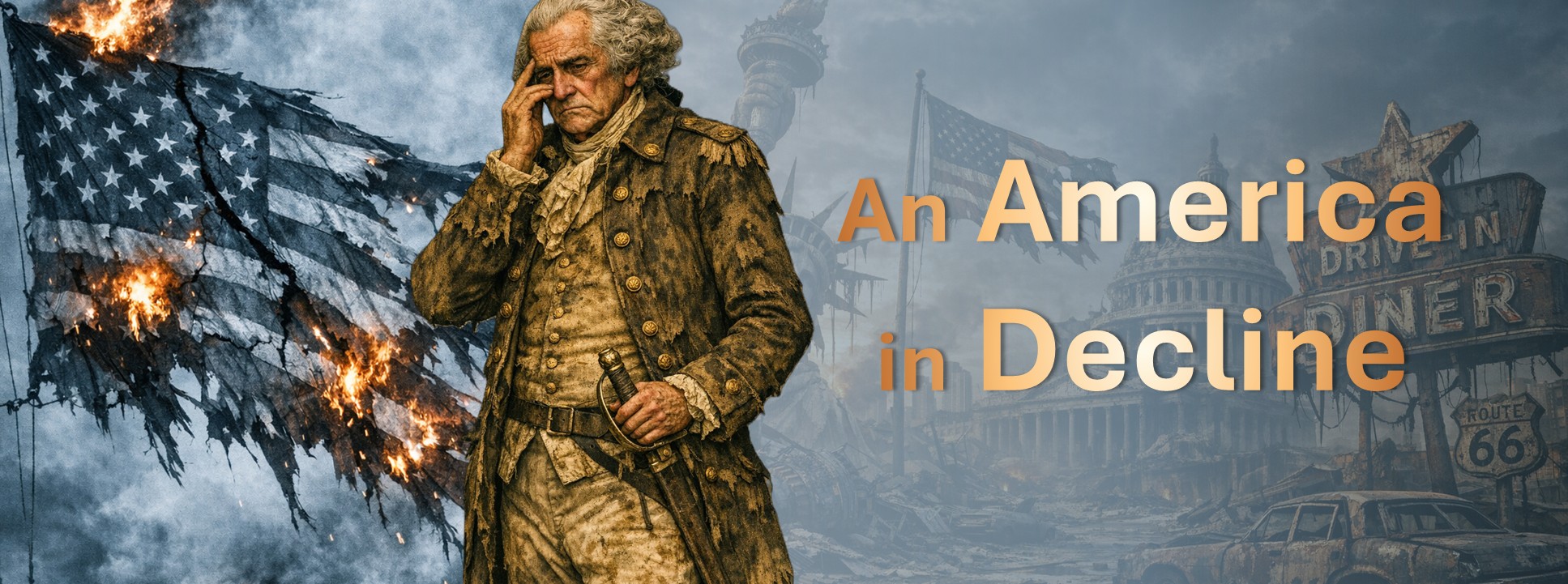
What we lost when a superpower lost itself — and why Europe must come of age
Frank Wiekhorst, March 2026 (GERMANY)
Growing up in a free Europe meant, for many of us, dreaming of America. America the country that went to the moon. The country that bottled the taste of freedom and put a piece of the American Dream into our hands with a Coca-Cola.
Movies like Smokey and the Bandit were a cipher for an America that still liked itself: not perfect, but confident. Playful. Capable.
Later came the Commodore 64, Apple, Back to the Future, Dirty Dancing, Michael Jackson, Madonna, and Top Gun. And that wasnt all: breakdance, basketball, Magnum, Miami Vice. We loved our America.
I was seventeen when I rode a Greyhound bus from New York to Mexico City three weeks through the landscape of my life dream. And when I spent entire summers a few years later in the dazzling white of Washington, D.C., my baseline feeling was simple: happiness. Freedom. Speed.
But that America is gone. And I miss it. Many in my generation feel the same. We lost something. And of all people, the Bo Bandit in me Burt Reynolds, half shrug, half grin says: well. Thats how it is. Always look forward. Theres a new horizon.
That is exactly where the question begins: what happened? And what does it mean for us in Europe when a superpower loses not only political strength, but also its intellectual and cultural center?
The pillars of the America myth are eroding
America is not experiencing a sudden crash, but a slow erosion in four dimensions: geopolitical power, moral authority, institutional stability, and cultural appeal.
The Trump administration is less the cause than the symptom: a warning light in the cockpit, suddenly glaring, making visible what has been growing for a long time. Trump is an amplifier and a stress test not the explanation, but the moment when hidden developments can no longer be ignored.
Anyone who speaks of Americas decline owes, first, a precise definition of what exactly is declining: not only influence abroad, but binding force at home; not only the loss of prestige, but the loss of self-restraint, competence, and trust the qualities that carry everyday order.
Cultural appeal
Cultural appeal is not pop culture. It is trust: the quiet conviction that a country has its fundamentals under control competence, self-leadership, institutions, proportion. It doesnt end when mistakes happen. It ends when the gap between narrative and reality becomes too wide.
An early, globally visible crack was the financial crisis triggered by the United States: when asset-backed securities collapsed, it wasnt only a market segment that imploded, but a piece of the narratives credit. Confidence in ones own strength was greater than the economic substance behind it. America may forget the fast-moving faster Asia and Western Europe have not forgotten.
Four things have acted like sand in the gears of that appeal ever since:
- Basic skills & education: Reading, writing, math, judgment — not in the elite, but in the middle. A superpower lives on the judgment of its middle class. When that crumbles, every grand narrative turns into a show. And Europe would be wise not to make the same mistake.
- Health & capacity to work: Resilience, stress tolerance, self-leadership. An exhausted society becomes either aggressive or apathetic. Self-leadership isn’t a wellness concept — it’s the precondition of freedom. Yet in 21st-century America, universal health insurance is treated as an indicator of creeping socialism.
- Service culture & institutions: Agencies, police, schools, courts — professionalism or friction. Institutions are everyday life. When professionalism is replaced by friction, cynicism sets in. And cynicism is the beginning of the end. The much-praised American service culture is eroding, too. Anyone who has watched America over the decades can see it clearly. New York — the Big Apple, the City — no longer smells like momentum. It smells like marijuana.
- Public discourse & media logic: Debate or theater. When conflicts are no longer resolved but only monetized, a country loses its internal capacity to steer itself — and politics becomes performance. One of America’s main exports is global hysteria, fueled by U.S.-based social media companies. Here, too, Europe should not follow the American path.
Institutional stability
On September 30 and October 1, 2025, Secretary of Defense Pete Hegseth and Donald Trump appeared in Quantico, Virginia, before the assembled top military leadership according to media reports in rhetoric that triggered massive internal criticism and even constitutional concerns.
What matters is not the single sentence, but the breach of role: when political staging enters spaces that live on professionalism, distance, and self-restraint, leadership becomes a stage and institutions become scenery.
And then I think of Alexander Haig. NATO Supreme Commander. White House Chief of Staff. Secretary of State. A man who didnt work through volume, but through weight. When Haig sat in a room, the room became quieter not out of fear, but instinct. Because everyone knew: here sat someone who did not treat institutions as scenery, but as obligation.
Haig was no moral preacher. He was a professional. And precisely for that reason, dangerous to anyone who wants to turn an institution into an audience.
Watergate is the right foil: not because Haig talked Nixon into resigning, but because it was still visible then that there were people with institutional weight who could set limits for a president without microphones, without theater.
Today that seems rarer. Not because America has no smart minds left, but because authority no longer comes from office and duty, but from volume and faction. Whoever contradicts is not seen as a corrective, but as an enemy. And where every corrective is declared an enemy, institutions wear out.
The absurd part is this: that internal weakness is now being exported outward.
At the World Economic Forum in Davos (January 2026), Gavin Newsom, Governor of California, accused Europeans of lacking backbone in dealing with Trump — too much bowing, too much appeasement, too much “niceness” masquerading as diplomacy.
You can argue about Europe. But the episode is revealing: when top American politicians start commenting on Europe’s spine while the structure at home is creaking, that isn’t a sign of strength. It’s a symptom of a fundamental American helplessness.
Moral authority begins at home. Those who demand it abroad are often admitting that it no longer works reliably where it matters most.
Moral authority
Moral authority is not moralizing. It emerges when power visibly binds itself: through restraint, through respect for roles, through the willingness to accept limits even when one could push them.
That is why democracies do not live only from enforceable law, but from conventions: tone, boundaries of respect, acceptance of procedures, acceptance of defeat, restraint from revenge. These are not manners. They are the shock absorbers of order.
This erosion rarely begins with a president. It begins in the audience in the habituation to the idea that principles become negotiable in an emergency.
After 9/11, the West including America gradually learned to treat freedom as a risk and the rule of law as a luxury that can be cut back in exceptional circumstances: more surveillance, less privacy, more purpose, less principle. Much of that was well-intended and security-driven but morally effective: it shifts the inner grammar of democracy.
When fundamental rights first become a matter of trade-offs, decency later becomes a tactic. In such a climate, someone like Trump can not only appear he can succeed.
Trump stands for a shift that further erodes that authority: not because he is the first to want power, but because he attacks the unwritten norm that institutions should not be treated permanently as enemies. Where self-restraint is seen as weakness, every rule becomes a tactical question and legitimacy becomes loot.
Two hard examples show the mechanism:
- When appointments become loyalty tests and competence becomes secondary, the meaning of office flips from function to followership.
- When pardons and prosecutions are read as political signals, the message is: proximity to power matters more than equal standards.
The damage is not only legal. It is cultural: the idea of fair, general rules loses its weight.
Institutions can absorb this for a while. Moral authority cannot. It dies slowly when leadership turns into siege and trust into cynicism. Then stability is no longer self-evident, only provisional.
Geopolitical power
Geopolitical power is the ability to define goals, sustain them and think through the consequences of ones own actions.
That is exactly where decline shows: not in the loss of weapons or money, but in the loss of strategic self-discipline. Foreign policy becomes a sequence of gestures: loudly announced, poorly thought through, limited in effect and ultimately expensive for ones own credibility.
Three episodes mark this pattern.
First, Venezuela: a limited action that looked more like symbolic resolve than a plan that would change the situation sustainably.
Second, Greenland: the threat to treat the territory of a NATO partner as bargaining material. That was a shock because it hit the shared understanding of what the alliance is: a community of protection, not a predatory order. That Washington later backed down because it had not expected European resistance was, for Europe, a moment of self-confirmation and for the U.S., a moment of exposure: talk big, then fold in front of allies.
Third, the attack on Iran: a step that not only had to be read as a breach of international law, but strategically looked like flying blind.
Whoever acts like that puts themselves, in many eyes, on a track otherwise criticized in Russia: might as justification. And they risk consequences any practitioner has on the table immediately from escalation in the Gulf to the vulnerability of global supply chains.
These three episodes are not isolated. They form a picture. And that picture is not an argument of gloating, but of concern: the conduct of the United States appears internationally impulsive and ill-considered and it feeds justified doubts about its actual conventional military strength, for all nuclear deterrence.
A country that acts like this looks vulnerable. And vulnerability is a signal.
The problem is not that America makes mistakes. The problem is that mistakes start to look like patterns. And patterns are invitations especially where China has been testing for years how expensive Taiwan would really be for the West.
America a country that destroys its own strength in the name of patriotism
Decline does not show only in institutions and foreign policy. It also shows where a nation damages its own capacity to perform and does so, of all things, in the name of its own myth.
Over the past twenty years, the share of obese people in the U.S. has risen significantly a trend that points far beyond health questions.
According to data from the Centers for Disease Control and Prevention (CDC), the adult obesity rate in the early 2000s was around 30%. National health data (NHANES 20172018) show, by contrast, 42.4% of adults as obese.
This increase of more than twelve percentage points is not just a statistical shift; it stands as a symbol of a society increasingly failing at the consequences of its own self-image: the promise of limitless availability, constant acceleration, and permanent self-optimization.
The American culture of excess bigger, better, more turns against its own citizens. Advertising, consumer logic, and national narratives of freedom and unlimited possibilities create an environment in which moderation almost counts as betrayal of the American Dream.
The rising obesity rate becomes a visible symptom of a deeper decay: a culture that has internalized its own myths so radically that it risks suffocating on them.
That is admittedly blunt. But it points to a pattern: uncontrolled Americanism that undermines the foundations of the countrys own strength.
Talent as an imported good and why it suddenly no longer arrives
Unlike Europe, the U.S. has a regulated immigration policy that has traditionally been oriented toward American interests.
For decades, the United States systematically benefited from bringing the most gifted scientists in the world into the country a strategic advantage that contributed decisively to American innovative power.
Several specialized visa instruments made this possible, including H-1B (high-skilled workers), O-1 (extraordinary ability), J-1 (research fellows), and permanent immigration categories such as EB-1A and EB-2 NIW.
But after spectacular and highly publicized operations by the U.S. agency I.C.E. against foreign skilled workers and students, the question increasingly arises whether the U.S. can still convince brilliant minds from India, Asia, or Europe to continue their careers in a country whose immigration practice is perceived as unpredictable.
Axes that crumble
International axes that have always been extremely profitable for the U.S. are breaking open.
After the wrecking of the relationship with Europe, America has put another supposedly indestructible alliance at risk.
After the founding of the Kingdom of Saudi Arabia in 1932, a strategic connection to the U.S. quickly developed, motivated less politically than geologically: as early as 1933, Standard Oil of California received the concession for oil exploration, which led to the discovery of large deposits in 1938 and laid the foundation for Aramco.
This early cooperation formed a lasting symbiosis: the U.S. provided the young state with technology, capital, and later military protection, while Saudi Arabia guaranteed reliable oil flows and stabilized the global energy system through the pricing link to the U.S. dollar.
The meeting between King Abdulaziz and President Roosevelt in 1945 cemented this energy-political alliance, which for decades shaped geopolitical dynamics in the Middle East and American foreign policy.
After U.S. attacks on Iran in the winter of 2026, the conflict expanded across the Arab world. Dubai, Qatar, and Saudi Arabia came under fire and the crucial Strait of Hormuz was blocked, leading to an international price shock in energy markets triggered by American lack of restraint without concept and follow-up strategy.
At that point the world understood: the United States of America is, above all, one thing a risk. Globally, but also for the allied Gulf region.
And as if that werent enough, there are now the trade relations between the U.S. and Canada, which feel like a Road Runner cartoon: Washington casts itself as the cunning coyote, trying with ever-new tricks to slow Ottawa down only to end up falling into its own traps.
Canada (the Road Runner in this image), by contrast, keeps running friendly, stable, and with a composure that makes the contrast even more visible.
Consequences for Europe
Admittedly, the inward view of Europe does not look like unity. States are still struggling for military strength and economic punch.
And yet one should not overlook this: Europe has fundamentally recognized the problem and is surprisingly aligned on the goals. What is missing is less the diagnosis and more the execution.
An additional complicating condition is the responsibility for Ukraine, which is not an EU member and yet is European security reality. That binds strength, time, and political attention and it limits freedom of action vis-�e0-vis the former ally.
Europe has long understood that the next major conflict will not primarily be fought over raw materials or territories, but over data, dependencies, and digital sovereignty.
That is why de-Americanization as a term is gaining ground not as anti-Americanism, but as risk management.
When a German state like Schleswig-Holstein publicly managed to exit Microsoft ecosystems, that is less an IT project than a political signal: software monopolies are vulnerability. And vulnerability becomes a price in a world of strategic rivalry.
The same applies to the major platforms: trust in Meta, Google, and others is eroding. Not because Europe has suddenly become more morally sensitive, but because dependency is being re-evaluated. That hits the core of transatlantic economic relations.
For Europe and especially for Germany an uncomfortable duty follows: we must prepare for partially losing a central trading partner.
Not because we want it. But because the dynamic of mistrust, decoupling, and strategic self-assertion hardly seems reversible.
Protection then means: build alternatives, reduce dependencies, organize resilience before the break is forced.
Closing note
As recently as the summer of 2023, the U.S. was an obvious travel destination for us Florida with the whole family, New York with my son.
With my daughter I wanted to explore the East Coast in a few years, and for myself the dream remained to drive the Florida Keys and follow Hemingways traces in Key West.
But I will not take the risk that my daughter could be separated from me arbitrarily at entry by I.C.E. officers.
Today, a visit to St. Petersburg (Russia) seems more realistic to me than another entry into the United States.
I have to learn to accept that the America of my parents the country they emigrated to in the 1960s no longer exists.
Henry Kissinger once said that each century is shaped by a different nation.
Perhaps relations with the U.S. will normalize again at some point. But the American century is over. For good.
The Marlboro Man rides into the sunset.
And while I write this, my inner Bo Bandit Burt Reynolds speaks up again. He stands in front of me in a red shirt, straightens the cowboy hat, grins slyly, and says: “Who knows what tomorrow brings?”
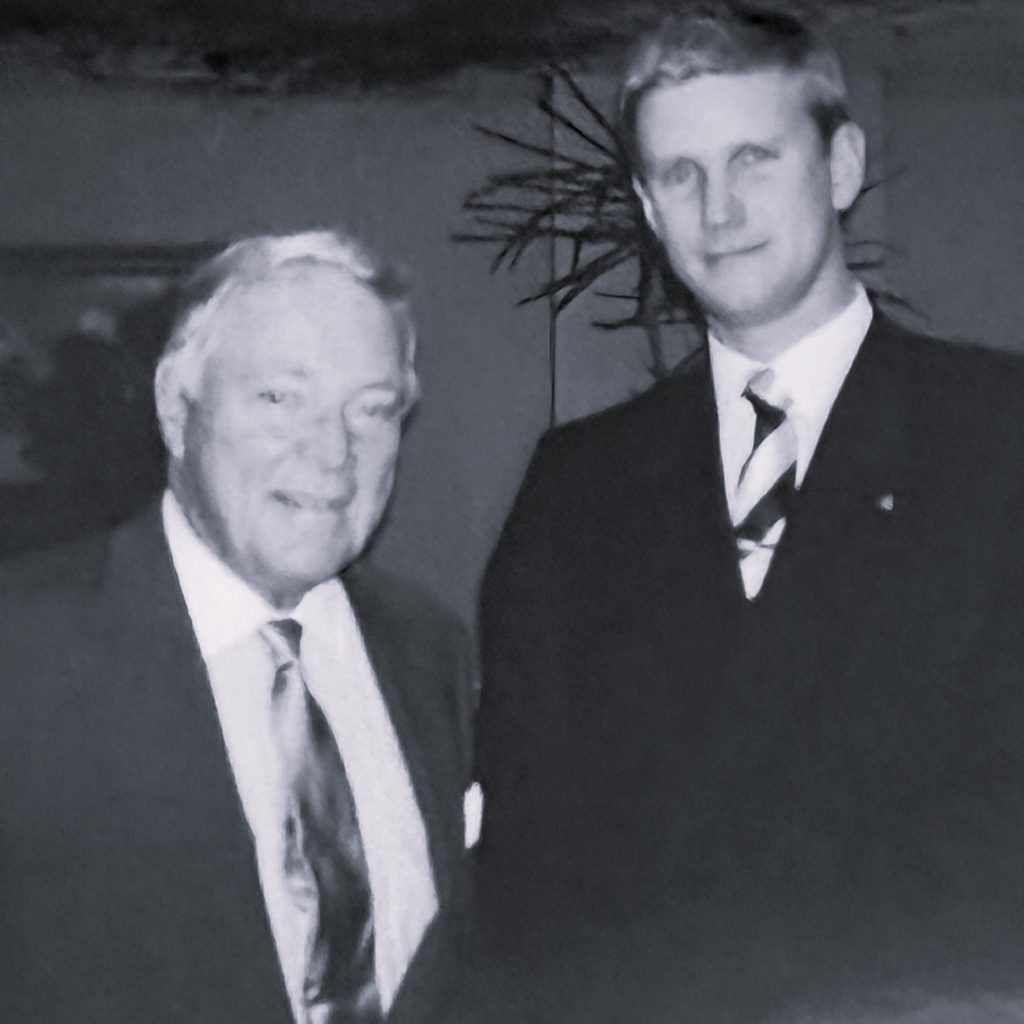
A visit with General Alexander Haig in his office in Washington, D.C., in the summer of 1996.
Frank Wiekhorst